<?xml version="1.0" encoding="utf-8"?><feed xmlns="http://www.w3.org/2005/Atom" ><generator uri="https://jekyllrb.com/" version="4.2.2">Jekyll</generator><link href="https://stevenrieder.com/feed.xml" rel="self" type="application/atom+xml" /><link href="https://stevenrieder.com/" rel="alternate" type="text/html" /><updated>2025-01-06T10:55:50+01:00</updated><id>https://stevenrieder.com/feed.xml</id><title type="html">Steven Rieder</title><subtitle>Website for Steven Rieder, postdoc in Computational Astrophysics at KU Leuven and AMUSE expert.
</subtitle><entry><title type="html">Simulating dynamics of multiple stellar systems in clusters</title><link href="https://stevenrieder.com/2023/09/11/poster-two-in-a-million.html" rel="alternate" type="text/html" title="Simulating dynamics of multiple stellar systems in clusters" /><published>2023-09-11T00:00:00+02:00</published><updated>2023-09-11T00:00:00+02:00</updated><id>https://stevenrieder.com/2023/09/11/poster-two-in-a-million</id><content type="html" xml:base="https://stevenrieder.com/2023/09/11/poster-two-in-a-million.html"><![CDATA[<h1 id="amuse-helps-you-simulate-star-clusters-with-binaries">AMUSE helps you simulate star clusters with binaries</h1>

<p>Creating tools from scratch to simulate dynamical interactions in star clusters is a lot of work.
Fortunately, we’ve already done this with the AMUSE framework (1, 2, 3), and we’re happy for you to use these!
In this post you will find some (interactive) examples for four tools, designed for creating initial conditions, simulating binary interactions, star cluster formation and visualisation.
You can download a Jupyter notebook with these examples here: <a href="https://gist.github.com/rieder/768b27959ee64d0f7ebe5af346972de5">Jupyter notebook examples</a>.</p>

<h2 id="masc">MASC</h2>
<p><em>make a star cluster - choose an IMF and spatial distribution, supports initial binaries.</em></p>

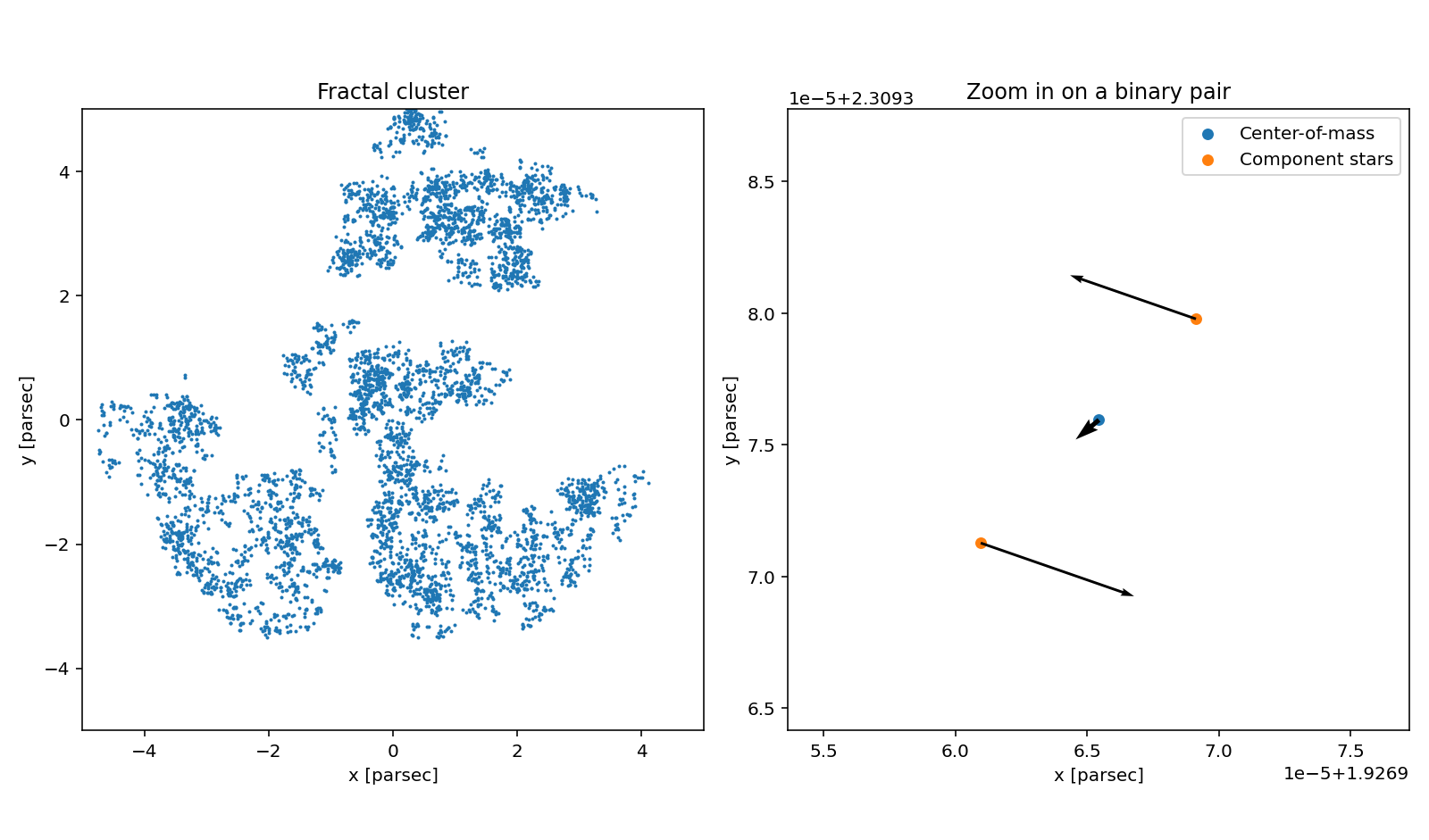
<p>MASC is a tool that integrates several functions in AMUSE to facilitate creating initial conditions.
It supports multiple spatial distributions (like Plummer, King and Fractal models), initial mass functions (Kroupa, Salpeter, flat) and can now also create initial binaries with various properties (semi-major axis, eccentricity, mass relation between the primary and secondary).
It can be run from the command line to create an AMUSE file, or directly from an AMUSE script (with more functionality).</p>

<p><img src="/assets/img/two_in_a_million/masc_example.png" alt="Example image of a fractal star cluster on the left and a pair of stars in a binary on the right" /></p>

<p><a href="/assets/examples/masc_fractal_cluster.html">Click for an interactive example</a></p>

<h2 id="multiples">Multiples</h2>
<p><em>takes care of interactions between a binary pair and any system that could disrupt it.</em></p>

<p>Multiples is a solution to the problem encountered by gravitational dynamics codes when simulating large systems with hard binaries in them: the time step would get too short, slowing the code down to a crawl.
Multiples detects systems of two (or more) stars within a specified interaction radius, and replaces these for the gravity code by a single particle.
When this particle encounters another particle, Multiples calculates the orbital phase of the stars in the system with a Kepler integrator, and then handles the encounter to its conclusion, e.g. the formation of (a) new multiple system(s) or the dissolution into individual stars, using a gravity code optimized for a small number of particles.
In this way, gravitational dynamics are sped up by a large factor compared to using a pure N-body code.</p>

<p><img src="/assets/mov/two_in_a_million/movie_multiples.mp4" alt="Movie of a binary-binary interaction resolved with Multiples" /></p>

<p><a href="https://gist.github.com/rieder/14320ecb0ac14598886e6293e9bab48e">Multiples example</a></p>

<h2 id="ekster">Ekster</h2>
<p><em>star formation from molecular clouds at moderate mass resolution.</em></p>

<p>With Ekster, we can simulate the formation of star clusters from molecular clouds.
It combines gravitational dynamics, hydrodynamics and stellar evolution with a recipe for star formation that forms stars on a proto-cluster basis, about 200 M<sub>☉</sub> at a time.
In (6), we used Ekster to simulate star formation in a spiral galaxy, while in (7) we used it to simulate a possible future of the Orion nebula cluster based on observed gas- and star distributions.</p>

<p><img src="/assets/mov/two_in_a_million/ekster_formation.mp4" alt="Ekster example figure" /></p>

<h2 id="fresco">Fresco</h2>
<p><em>visualisation of stars with extinction from dust - create mock-observations from simulations.</em></p>

<p>Fresco is a visualisation tool, that calculates the visual appearance of stars using their luminosity and temperature.
It calculates the stellar flux in several color bands, convolves this with a point-spread function (the PSF for Hubble’s WFC3 is included) and combines the result to a color image (mimicking visual observation).
Additionally, Fresco supports calculating extinction and reflection by gas/dust.</p>

<p><img src="/assets/mov/two_in_a_million/fresco_formation.mp4" alt="Fresco movie of cluster formation in Ekster" /></p>

<h2 id="examples">Examples</h2>
<p>At Github (3), we have provided many examples making use of one or more of these tools.
Please feel free to use and improve on these for your use cases.</p>

<h2 id="links-and-references">Links and references</h2>
<ol>
  <li><a href="https://ui.adsabs.harvard.edu/abs/2013A%26A...557A..84P/abstract">Pelupessy et al., 2013</a></li>
  <li><a href="https://www.amusecode.org">AMUSE homepage</a></li>
  <li><a href="https://github.com/amusecode/amuse">AMUSE developer page</a></li>
  <li><a href="https://zenodo.org/record/8333404">Rieder, 2023</a></li>
  <li><a href="https://github.com/rieder/amuse-masc">MASC developer page</a></li>
  <li><a href="https://ui.adsabs.harvard.edu/abs/2022MNRAS.509.6155R/abstract">Rieder et al., 2022</a></li>
  <li><a href="https://ui.adsabs.harvard.edu/abs/2023MNRAS.519.4142S/abstract">Sills et al., 2022</a></li>
  <li><a href="https://github.com/rieder/amuse-ekster">Ekster developer page</a></li>
  <li><a href="https://zenodo.org/record/7701608">Rieder &amp; Pelupessy 2023</a></li>
  <li><a href="https://github.com/rieder/amuse-fresco">Fresco developer page</a></li>
</ol>]]></content><author><name></name></author><summary type="html"><![CDATA[AMUSE helps you simulate star clusters with binaries]]></summary></entry></feed>